
Control the water source
Repair leaks, isolate intrusion, and prevent additional water from reaching the affected area.
Add a ready-to-use, label-driven treatment step to water-damage restoration and mold-control programs.
Vital Oxide is designed to fit after the water source is corrected, excess water is removed, affected materials are assessed, and visible soil or contamination is addressed. It supports the program; it does not replace source correction, drying, containment, removal, or professional judgment.
Sequence shown for education only. Use the current EPA label, project specifications, applicable standards, and trained remediation personnel.
A reliable mold-control program starts before product application. Use a documented sequence that addresses the cause, the moisture, the material condition, and the label requirements.
Repair leaks, isolate intrusion, and prevent additional water from reaching the affected area.
Remove excess water, establish airflow and dehumidification, and document moisture readings.
Identify affected materials, hidden cavities, exposure duration, and the need for containment or specialist support.
Clean or remove damaged materials as the project plan requires before applying the labeled treatment.
Use the current label, approved application method, surface directions, and full wet contact time.
Confirm dryness, inspect for returning growth or odor, retain records, and correct any recurring moisture condition.
The product label calls for special procedures and trained remediation personnel when more than 30 square feet is affected. Project conditions, containment, PPE, ventilation, disposal, and re-entry requirements should be determined by qualified professionals and applicable guidance.
Vital Oxide can support several parts of a restoration project, but the material, condition, application method, and current label must guide every use.
Use the applicable fungicidal and disinfecting directions for label-supported hard, non-porous surfaces after visible dirt has been removed.
The mildew stat directions address mold and mildew control on floors, walls, ceilings and fabric. Confirm that the specific material and finish support wet application.
Use only where the current label permits treatment and the material can tolerate the application. Do not assume every porous material is suitable.
The label includes directions for materials that will be removed and disposed of. Coordinate treatment, handling, containment and disposal with the project plan.
Ready-to-use chemistry helps crews reduce preparation variability while staying focused on coverage, wet contact time, documentation, and the moisture conditions that determine long-term success.
In a University of Tulsa investigation, Vital Oxide solutions inhibited growth of six test fungi on sheetrock and ceiling-tile samples under laboratory conditions. The same research reported that active growth could resume when treated materials remained water-saturated—supporting the need to eliminate moisture, dry thoroughly, and continue monitoring.
The study was funded by Vital Technologies. Laboratory findings do not replace a site assessment, the current EPA label, or project-specific remediation procedures.
Drying and source correction support the treatment program and reduce conditions that favor renewed growth.
Continued water exposure can allow growth to return, even after treatment. Product application cannot compensate for an unresolved moisture source.
The practical takeaway: treat the source, the moisture, the material and the surface—not just what is visible.
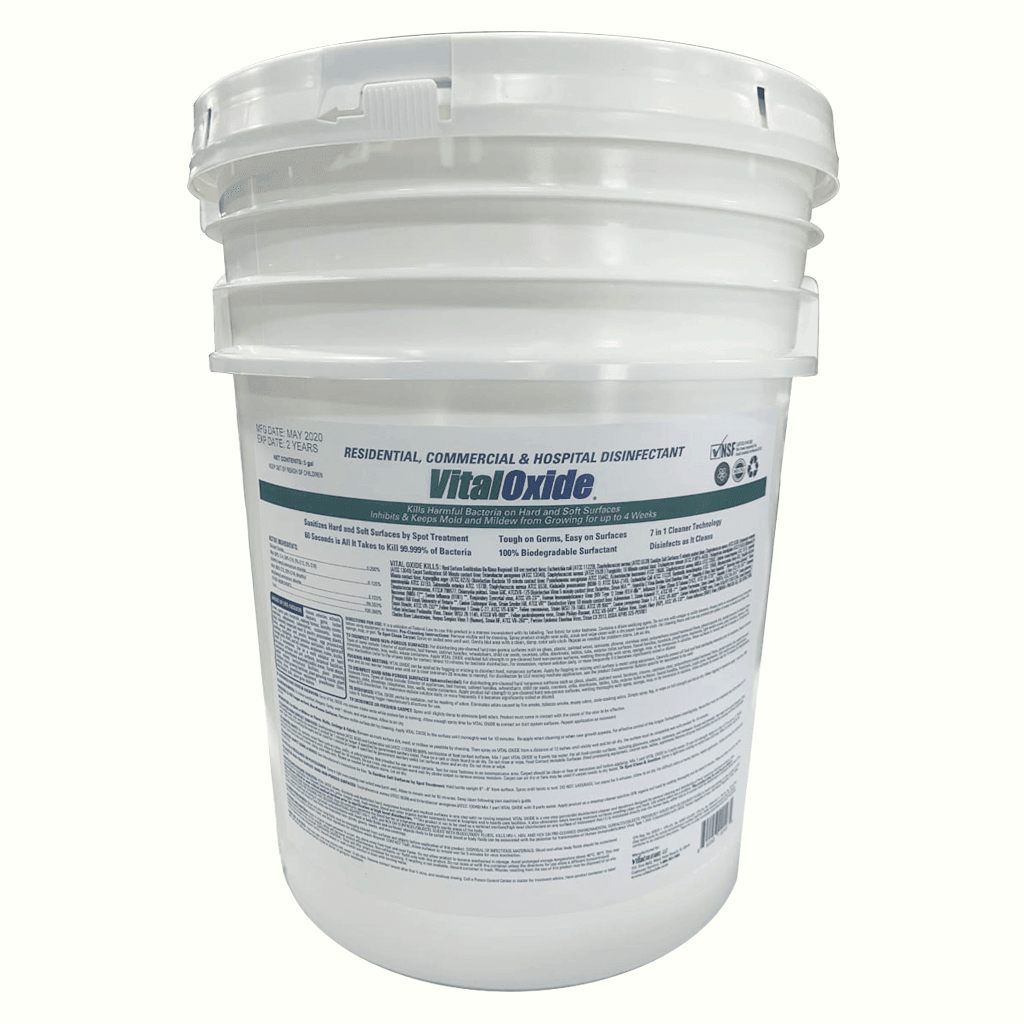
Use one-gallon containers for targeted work, maintenance inventories, and smaller restoration needs. Use the five-gallon pail when crews need more volume for professional applications.
Use the current label and supporting documentation when preparing scopes, crew instructions, procurement reviews, safety plans and customer records.
Current directions, organisms, surfaces, contact times, application methods and remediation language.
Open document →Product identification, handling, storage, exposure, first-aid and disposal information.
Open document →Laboratory context for fungal-growth inhibition on sheetrock and ceiling-tile samples.
Read summary →Review product registration information and additional supporting materials.
View resources →No. Vital Oxide can be used as one component of a comprehensive mold-remediation or water-damage restoration program. The water source, excess moisture, damaged materials, containment, cleaning, removal and verification still need to be addressed.
For the applicable mildewstat directions, clean the surface, apply until visibly wet, and keep it completely wet for 10 minutes before allowing it to air dry. Always verify the current EPA label for the exact surface and use.
The label includes mold-remediation and mildewstat directions that cover certain floors, walls, ceilings, fabrics and materials being removed for disposal. That does not mean every porous material is appropriate. Confirm the current label, material compatibility, project plan and manufacturer care instructions.
The label states that special procedures and trained remediation personnel should be used for larger affected areas. Follow applicable regulations, recognized remediation guidance, containment requirements, PPE procedures and the project’s written scope.
No product should be presented as a guaranteed stain-restoration solution. The label notes that mold stains may remain and may be irreversible. Material replacement, refinishing or separate stain treatment may still be necessary.
Correct the cause of recurring moisture first. The label calls for monitoring, with reapplication when growth or odor returns and according to the relevant directions. A recurring condition is a signal to reassess the source, drying, hidden areas and material condition.
Choose the right project size, keep the current documents available, and support every application with moisture control, material assessment, complete coverage and verification.
At this time we are unable to ship the following items to Indiana:
• 32 oz. & 128 oz. Combo
• 128 oz. & Fogger Combo
If you have any questions or need assistance, please contact our customer support team at: 1-800-303-5405